Tuesday, September 28, 2021

Pleasure Beach History 1929 - 1953

Patrick Collins (1859 – 1943) was one of five children of Irish parentage who had come to England in the nineteenth century. When he was ten, he and his younger brother John travelled fairs with their father, and he would go on to establish his own fairs in adulthood. By 1882, he ran many of the fairs around Birmingham and the Black Country, where he had settled with his wife, Flora (née) Ross and their children, named in the family tradition, Patrick, and John. He had an interest in cinematography and included bioscopes at his fairs. He later he went on to own 13 cinemas. He was an accomplished and respected showman and served as president of the Showman’s Guild of Great Britain from 1920 until 1929. Later in his life he was involved in politics, firstly as a local councillor for Walsall, before going on to serve as an MP for two years from 1922. He was elected Mayor of Walsall in 1938.

The Collins'
Pat Collins, front left, and his son John, centre in light suit, at the Nottingham Goose Fair of 1936.

Pat was awarded the lease of Pleasure Beach for the 1929 season (take a look at this Blog post for Pleasure Beach History 1909 - 1928 to read how this cam about). His son John went to Great Yarmouth to oversee day-to-day operations, assisted by general manager R. J Minns. John’s first order of business was to obtain a replacement for Iles’ Scenic Railway. In the end, two rides were built at the park; figure-8 roller coaster and a water chute, which both opened in 1929. The figure-8 roller coaster featured single cars which were hauled up a lift-hill to run back down to ground level on track in a figure of eight pattern. It was a side-friction coaster, and the cars had wheels on their sides as well as underneath, and they ran in a trough-shaped wooden track which guided them. These rides were popular at the time, though not in the same league as scenic railways. Only one such ride remains today, and it is the oldest roller coaster in the world – Leap-the-Dips opened in 1902 at Lakemont Park, near Altoona, Pennsylvania, USA. Follow this link for a video of this ride.

Pleasure Beach entrance in 1929
The entrance to Pleasure Beach in 1929. This sign was erected at the beginning of the season, and would stand at the entrance for thirty years. 

Pleasure Beach 1929
This image, also from 1929, shows a variety of stalls and rides, including The Whip (front centre), Water Chute (background left) and Figure-8 (background right). The general layout of stalls along the left and attractions along the right persists today.

Figure 8
The Figure-8 roller coaster. The shallow drops such rides have are evident in this image. The tall tower to the left is Jack & Jill, which was a slide ride, opened in 1925. This image is from 1930 or 1931. 

The Water Chute was rather different to the type which had operated at the park before, for this one featured a large oval track and boats with wheels. The boats were hauled by a chain up an incline, rolled around a bend at the top of the ride, plunged down to ground level through a pool of water to circle back round to the loading area, ready to go again. The concept had been invented by a German showman called Hugo Haase, who premiered it at the International Press Exhibition at Cologne in 1928. In fact, the ride constructed at Pleasure Beach was the same ride that had operated in Cologne, although it would only operate at Pleasure Beach for one season before going to the Collins’ other park at Barry Island for 1930.

Water Chute
View of the park and along the seafront (Winter Gardens and Wellington Pier are in the background at the top of the image) from the top of the Water Chute in 1929. 

John installed a miniature railway courtesy of Nigel Parkinson, which opened in 1930. This was a 15” gauge railway, with a rather grand, albeit suitably sized, booking office and two island platforms adjacent to the Jack & Jill ride. The track, just over 500 metres in length, ran south alongside South Beach Parade before looping north near the junction with Main Cross Road, through a short tunnel dug into the sand dunes, and back to the station area. A small steam locomotive called Mighty Atom (later renamed Prince of Wales) was used with coaches based on mainline designs of the era. There was also a diesel-powered train. The railway was short-lived though and it was removed after the 1937 season.

Pleasure Beach during the early 1930s would be recognisable today. A row of stalls along the beach side of the park offered cards, darts and various other games to entice visitors to spend their money. A variety of indoor attractions along the road side of the park provided entertainment, including 'freak shows', which were popular at the time. A Globe of Death, a large spherical cage in which motorcyclists would daringly ride round-and-round, sometimes in pairs, provided a dramatic attraction for visitors, and the development of thrill rides really began to take off during this decade. However, the Collins’ desired something that would really draw crowds. Pat believed the future of amusements lay in, what he called, the big stuff. They looked to the Continent for inspiration and found their answer at the Paris Colonial Exhibition.

Miniature Railway
Rolling stock on the Miniature Railway.

Side shows
Crowds gather around one of the 'freak' shows.

A large Scenic Railway had been installed at the Exhibition's amusement park. It was operated by Hugo Haase, who the Collins' had done business with only a few years earlier, when they bought his Water Chute for Pleasure Beach. Pat Collins purchased the ride for Pleasure Beach for £15,000. Whilst the components were being shipped to England, the Figure-8 was dismantled and the site prepared. The park opened for the 1932 season on 14 May, and the Scenic Railway, River Caves, which had come with the Scenic Railway and constructed underneath and around the ride's track, and Water Dodgems, which the Collins had presented at London's Olympia the Christmas before, welcomed their first riders. Unfortunately, the success of the 1932 season was overshadowed by a fire, which destroyed the Noah's Ark ride on 20 September.

Scenic Railway 1932
The Scenic Railway in 1932, decorated in plaster sculpted to resemble mountainous terrain.

The park opened for the 1939 season on 8 April. The political situation in Europe had been deteriorating for some time, and as the year went on the prospect of war loomed. Visitor numbers declined throughout the summer and in July, Pat asked the Council for permission to open on Sundays during August to boost revenue. The Council declined. Soon after, and until the declaration of war, the town changed to put itself on a war footing. The first evacuees from Thames-side towns arrived from 1 September, on the first leg of their journey into the relative safety of the countryside. Pleasure Beach opened for Easter 1940, but it was soon clear business could not continue. In May, the Council agreed Pat’s offer for 50% takings, and a minimum of £2000 for the duration of the war, in lieu of the usual rent and rates.  

Evacuation of the town commenced on 2 June 1940 and the first air raid was just over a month later on 11 July. Great Yarmouth suffered extensive damage at the hands of the Luftwaffe, and between 11 July 1940 and 1 June 1944 nearly a thousand bombs were dropped on the town, and ten times as many incendiary devices. These included four high explosive bombs dropped north of the Pleasure Beach on 7 December 1940 and approximately fifty incendiary devices dropped on South Beach Parade on 21 September 1941. Despite this the Pleasure Beach site, which had been reduced to just the entrance gate, stalls, indoor attractions and Scenic Railway, survived intact. 

Sadly, Pat Collins, who had returned home to Bloxwich for the war, died on 9 December 1943. Pat’s death was followed in 1945 by the death of Mr Minns, who had been General Manager at Pleasure Beach for over ten years and had overseen the transition from Iles’ to Collins’ lease and installation of the Scenic Railway.

Many of the showmen who had operated their own rides at the site did not return after the war. John, now head of the Collins family empire, filled the spaces with his own rides and park was reopened for August Bank Holiday in 1945, shortly before the War officially ended. Thrill rides were the order of the day. Their installation at amusement parks during the 1930s was curtailed by the war but by the end of the decade, Pleasure Beach was home to rides such as the Flying Fleas, Moonrocket and Tilt-a-Whirl. Rides such as the Juvenile Big Wheel and Helter Skelter (Slip), provided by the Cole brothers, catered for younger visitors. Kiddies Corner was an area of the park dedicated to more sedate rides for children, with miniature rides and novelty bicycles. 

Tilt-a-Whirl
Tilt-a-Whirl in 1948. Image reproduced with permission of the University of Sheffield.

Moonrocket
Moonrocket 1948. Image reproduced with permission of the University of Sheffield.

Reohorn’s Gallopers
Reohorn's Gallopers in 1948. This may be the first Gallopers to operate at Pleasure Beach. Image reproduced with permission of the University of Sheffield.

Juvenile Big Wheel
Juvenile Big Wheel 1948. This ride stood near the entrance to the park (the tower to the left supports the entrance sign). Image reproduced with permission of the University of Sheffield.

Cole’s Slip
Cole's Slip is prominent in this view from 1948, which also includes part of Reohorn's Gallopers, the Sky Flyer, and the Water Dodgems (left, background). Image reproduced with permission of the University of Sheffield. 

General View 1949
Aerial view of the park in 1949. Credit: Britain from Above. 

John sought permission for the park to open on Sundays in 1950, although this was rejected by the Council. He tried again two years later and offered an increase in rent for a new lease of 14 years as well as permission to sell refreshments, sweets and toys. The Council were still not keen on the idea of Sunday opening and when the offer was considered by Council’s Committee, they were so unhappy they recommended Collins be told to remove all attractions from the site when his lease expired on 31 December 1952. Fortunately, relations between John and the Council sweetened, and a revised offer was accepted with only two months left on the lease, although the Council once again declined his request for Sunday opening and for the sale of refreshments. The contentious issue of Sunday opening would rumble on for another year, when finally, in December 1953 permission was granted when the Council bowed to public pressure.

Strato Globe 1951
The Strato Globe in 1951. Image reproduced with permission of the University of Sheffield.

General View 1951
This image, also from 1951 shows the Speedway, Flying Fleas, Collins Gallopers and Cole's Slip. Image reproduced with permission of the University of Sheffield.


Collins Gallopers 1951
Collins Gallopers in 1951. Image reproduced with permission of the University of Sheffield.

Collins Gallopers 1953
This is a different set of Collins' Gallopers, at the park in 1953. Image reproduced with permission of the University of Sheffield.

The Rotor 1953
The Rotor in 1953. Image reproduced with permission of the University of Sheffield.

John had recovered the Collins empire following the war, and by this time he also had endeavours at Battersea Fun Fair and Seaburn. His sons John and Patrick had settled in Wales and oversaw the day-to-day operation of their Barry Island amusement park. By the end of 1953 he no longer wanted, or could, commit the time to Pleasure Beach that it needed. He sublet the site to Albert Botton, who was Managing Director of Botton Brothers Ltd, and Albert and his wife Lottie took over day-to-day operation of the park for the 1954 season. This arrangement continued until John's site lease expired at the end of 1958. Botton Brothers was awarded a new lease and John, who had retained ownership of the Scenic Railway, sold it to Botton Brothers and his involvement with Pleasure Beach ended.

Below is brief footage of Pleasure Beach from the early 1950s (it's a compilation of two separate videos) showing various rides and attractions. 


Tuesday, September 7, 2021

Wristbands

The first wristband went on sale at Pleasure Beach thirty years ago today. 

Wristband advert from 1991.
The first advertisement for wristbands in the 30 August 1991 edition of Eastern Daily Press.
 
Later in the week came this advertisement with more information. From the 3 September 1991 edition of Eastern Daily Press.

Following the 1991 summer season, Pleasure Beach trialled wristbands for the weekends the park was open during September. Priced at £7 each, they allowed the wearer unlimited goes on all the rides, although tokens, priced at 25p each, were still available to purchase for anyone who wanted to ride only a few times.

For most of its history, the park has operated on the pay-as-you-ride principle, initially using cash and later, tokens, although there was a brief, unsuccessful, trial at pay-to-enter in 1983 (under 5s went free, 5-10 year olds, pensioners and disabled customers paid £2 and everyone else paid £3). Wristbands then were a departure from the norm, but it was hoped they would provide additional income against the backdrop of declining British seaside tourism. Fortunately, they proved popular and the trial was a success, so much so that they were available for sale throughout the 1992 season, priced at £7 for adults and £4 for children.

Leaflet from 1992
Large-scale leaflet for Pleasure Beach from 1992, the first year wristbands were available for sale throughout the season. The featured rides are Condor, Looping Star, Log Flume, Flying Carpet, Roller Coaster (the white train is now the orange train), and Fun House.

Wristband advert 1994
Advert from the 22 July 1994 edition of Eastern Daily Press, offering a discount on token and wristband purchases. 1994 was the last season wristbands would be available until 1998. The rides featured are Condor, Looping Star, Toboggan, Fun House, a big wheel (there wasn't a big wheel at the park that year), Roller Coaster and cars from the Formula 1 ride.

Wristbands were available throughout the 1993 and 1994 seasons, before the park reverted to pay-per-ride by token. If there was concern wristbands offered value that was too good and the effect on revenue, this did not last long, as wristbands were available to purchase again 1998, still priced at £7. As a trial, they were valid only until 6pm, after which only tokens were accepted. Whilst the return of wristbands proved popular, the time restriction did not, and it did nothing for the park’s evening business. Wristbands returned in 1999 priced £8 for the whole day. 

There followed a period of experimentation, starting with a family of four weekly wristband for £175, and including parent and toddler versions, as well as half-price evening wristbands in 2008 and discounted evening wristbands in 2012. Some offers were more successful than others. The next big trial came in 2013 when season tickets were introduced. Priced at £70 for the year, they allowed the holder an unlimited number of wristbands throughout the season. A promotion in the local newspaper for half-price season tickets proved extremely popular with locals.

2008 leaflet
Leaflet from 2008, advertising evening wristbands, which were trialled that year for the first time. The featured rides are Sky Drop, Evolution, Log Flume, Formula 1, Mulan, Roller Coaster, Snails and Twister.

Wristbands and season tickets were available each season until 2019. Like the rest of the tourist industry, Pleasure Beach was hit hard by Covid-19 and had to adapt to new ways of working to survive. Limited pay-to-enter was implemented in 2020 and again in 2021, ending a 22 year period in which wristbands were available.

2019 leaflet
Leaflet from 2019, the most recent year in which wristbands were available. 

Saturday, August 28, 2021

Keeping up Appearances

Keeping up Appearances was a popular British sitcom which originally aired during the early 1990s. Reruns are still shown on TV channel Gold, and all six series are available to watch on demand through Britbox. Many scenes featuring in season 5, episode 1 were filmed at Great Yarmouth, with extended scenes filmed at Pleasure Beach. 

Patricia Routledge and Clive Swift, playing the two main characters Hyacinth and Richard Bucket (it’s Bouquet!), and others, descended on Pleasure Beach on 12 July 1995, along with the production crew. Over two days, a variety of scenes were filmed on rides including Gallopers, Dodgems, Fun House and Haunted Hotel, as well as various scenes using the park as backdrop. The episode, The Senior Citizens’ Outing aired on 3 September 1995.

Patricia Routledge with Buttons and Leo
Patricia Routledge with Pleasure Beach mascots Buttons and Leo. Credit: Alan Hall.

One of the scenes featuring Patricia Routledge riding the Haunted Hotel is available to view on YouTube. 


Thursday, August 26, 2021

The Giant

The Giant terrified children visiting Pleasure Beach during the 70s, 80s and 90s. It’s 20 years now since The Giant was removed, but his legacy lives on at Pleasure Beach.

The Giant in 1976
The Giant and accompanying diorama near the entrance to the Snails ride in 1976.

Laminators Limited of Kessingland, Suffolk, was contracted to build the 30 foot tall model to be used in a Jack and the Beanstalk themed diorama for the Snails ride. A gentleman by the name Derek Waghorn single-handedly built the model using glass reinforced plastic (GRP, fibreglass) on a steel frame and painted it - a process which took him nine weeks. Once completed, the model, which weighed a tonne, was transported to Pleasure Beach and erected near the entrance to the Snails ride by Pleasure Beach’s own maintenance team in July 1967. 

The Giant being painted
Derek Waghorn puts the finishing touches to The Giant from atop a ladder, outside the workshop in which he made the figure.

The Giant was accompanied by a house made from a boot inhabited by a witch. A model witch flying a broomstick was driven by a mechanism so it seemed she was flying around the chimney of the house. A mechanism within The Giant also caused his arm with club to move up and down. 

The Giant
The Giant was an imposing figure, towering over small children waiting their turn on the Snails ride. Credit: David Palmer.

The giant and boot house
The Giant, boot house and flying witch are seen on this postcard from the mid 1980s. Some of the scenic cladding has been removed by this point.

The Giant's face
The Giant's face, showing David Waghorn's attention to detail.

The boot house and witch
The boot house and flying witch, accompanied by her cat.

Despite its popularity, The Giant and the rest of the diorama was removed without fanfare at the end of the 2001 season. A diorama, inspired by Jack and Beanstalk, was painted on the Scenic Railway cladding near the entrance to the Snails ride and a new giant model was installed, accompanied by a giant-sized table and sacks of gold coins. The Giant’s legacy lives on however. The Dodgems ride was revamped ahead of the 2021 season with new signage featuring various Pleasure Beach figures. The giants go head to head to tell drivers no head on bumping. 

The new giant in 2004
The new giant and diorama inspired by Jack and the Beanstalk in 2004.

Giants go head to head
The old and new giants feature in new signage for Dodgems, installed in 2021,twenty years after The Giant was removed. Credit: Pleasure & Leisure Corporation Ltd.

Tuesday, August 10, 2021

Pleasure Beach History 1909 - 1928

John Henry Iles (1871 – 1951) grew up in Bristol and started his working life as a timber merchant, although he became a true entrepreneur. He had a passionate love of brass band music, and whilst his brass band was on tour in America in 1906, he saw one of Thompon's scenic railways operating at Coney Island in New York. He immediately realised the potential for such rides back home, and he visited Thompson’s New York office and bought the rights to build such rides in Britain. He opened Britain’s first scenic railway in Blackpool in 1907.

Iles' brass band members
Iles' brass band, Besses o' th' Barn, on their World Tour in 1907. Iles is centre, in the white hat.

Charles Blake Cochran (1872 – 1951) was an actor at 17. He attempted to pursue an acting career in America but returned to Britain in 1902 unsuccessful, and found he was better at promoting theatre and revues than acting. Consequently, he went on to produce theatre, but he was well-travelled and became aware of the developing interest in amusement rides in Britain and how lucrative such business was.

Portrait of Charles Blake Cochran
Charles Blake Cochran.

On 9 March 1909, Yarmouth Town Council met at the Town Hall for its monthly meeting, during which they read a letter and telegram that Cochran had prepared, which applied to lease an area of sand dunes 600ft long and 120ft wide south of Nelson Gardens to install a scenic railway and side shows. Rent of £650 in advance and for each year was offered, together with payment of all rates and taxes. The Council’s Beach Committee recommended a lease of five years, and in addition to the terms Cochran had set out, they decided there was to be no other attractions, kiosks, stalls, refreshments, or music, and the site could not trade on Sundays.

The Council had previously received a similar application from someone else, but their offer of a lease on the required site for a rent of £500 and similar terms had been declined. This time, Cochran was happy to accept the terms and contracts between his Yarmouth Beach Amusements Ltd. company, Iles of the L. A. Thompson Scenic Railway (Yarmouth) Ltd. company and the Council were exchanged on 20 May 1909.

Construction of the Scenic Railway began in June. It was built to the design of William Alexander Napier, an architect for the L. A. Thompson Scenic Railway Company. Timber and labour were sourced locally and over 160 men worked on the ride’s construction. Another attraction, the Katzen Jammer Castle, which was a funhouse style attraction, was built alongside the Scenic Railway. The site was named Sands of Mirth and opened on 24 July 1909, the date of completion of the Scenic Railway having slipped by only one week. At 7pm that day, the ticket office was opened, and a queue of visitors formed to pay their fare. Cochran and his wife were passengers on the first train, and they were joined by a local alderman and clergyman.

Scenic Railway under construction
Scenic Railway under construction on the sands of South Beach.

Scenic Railway and Katzen Jammer Castle
The Sands of Mirth shortly before opening. The Scenic Railway is nearly complete and the Katzen Jammer Castle stands alongside.

Scenic Railway, showing the various drops and some of the theming
The Scenic Railway in 1909. 

Extract from Eastern Daily Press newspaper with advertisement for Sands of Mirth
Advertisement for the Sands of Mirth from Eastern Daily Press newspaper, 2 August 1909.

The design of the ride was typical of scenic railways of the time and featured two long loops of track, each with a lift hill provided with a steel cable for hauling the trains to the top, on a superstructure of pitch pine. It occupied a space around 600ft by 110ft, and the track reached a height of approximately 40ft. The Scenic Railway at Margate's Dreamland amusement park, which was also installed by Iles and opened in 1920, has a very similar design and is still in operation today. Trains were formed of three cars linked together with a brakeman riding the train to check its speed where necessary and to stop it in the platform. Like many scenic railways, the ride was to be clad in plaster sculpted to resemble mountainous terrain, however there was not enough time to fully decorate the ride before the main tourist season, and the scenery was not completed until the following year. This consisted of plaster rendered to resemble mountainous terrain and other scenes, along with over 3000 light bulbs.

A new attraction, the River Caves, opened on 2 July 1910, providing the second of the two side shows permitted by the lease. It consisted of a gently inclined water course snaking its way around and under the structure of the Scenic Railway. A paddle wheel was used to lift water to the top of the incline, while a chain lift was used to haul the boats up from ground level. The ride made use of nearly 70,000 gallons of sea water. Elements of the Scenic Railway theming were used to good effect to provide caves and other scenic elements through which the water course river was sent, with the boats taking their passengers on an adventurous journey. River Caves were popular attractions of the period, although few examples remain today.

Yarmouth Beach Amusements Ltd applied to install another ride as an additional attraction in 1910. Initially, they wanted to install a ride called Merry Widow Waltzer, before changing plans to ask for permission to install a joy wheel instead. The Council did not approve either, resolving to stick to the terms of the lease permitting only two side shows, although they offered to approve Joy Wheel as a replacement. In the end, the Katzen Jammer Castle was demolished to make way for Joy Wheel, which opened in 1912. Joy wheels were popular attractions at the time and consisted of a wooden disk at the centre of an enclosure. Riders would sit on the disk, which rotated at increasing speed until everyone had slid off. Their popularity was relatively short-lived, although a few examples remain today in travelling fairs and versions may be seen at science fairs or museums to demonstrate principles of physics.

The Scenic Railway and Joy Wheel at night, lit up.
Pleasure Beach in 1912, showing the Scenic Railway and Joy Wheel lit up.

The Scenic Railway in 1912 with cladding sculpted to resemble a mountain.
A train waits in the station for riders.

The name Pleasure Beach was first used to refer to the site in May 1912, appearing in an Eastern Daily Press advertisement on 24 May 1912, and throughout the rest of the month.

Extract from newspaper showing the name Pleasure Beach used for the first time
Advertisement from Eastern Daily Press newspaper dated 24 May 1912, showing the name Pleasure Beach in use for the first time.

Earlier that year, Yarmouth Beach Amusements Ltd. applied for permission to install a miniature railway to run from the site along South Beach to the harbour mouth, and with terminus stations at each end. Whilst merit in this idea was seen by some, others were concerned there were already too many amusements operating in the area and more would be undesirable. Accusations were made the company had canvassed members of the Council for approval, which did not go down well, and the application was refused. The site continued to operate at a modest level until the outbreak of World War I.

Relations between Cochran’s and Iles’ companies soured quickly. Yarmouth Beach Amusements Ltd. had initially been paying rates to the Council as necessary, but soon stopped doing so; informing the L. A Thompson Scenic Railway (Yarmouth) Ltd. company it was their responsibility, and referring to a loop-hole in the contract. Iles’ company, intending only to involve themselves in providing the ride rather than operating the site, was naturally unhappy about this. Both companies appeared in court in July 1912 in dispute as to who was liable to pay the rates. However, the matter was not decided at that time, and in fact the dispute would rumble on for many years. It was finally settled in November 1917 when the council accepted £500 from Yarmouth Beach Amusements Ltd. in settlement of its claim for outstanding rates and offered to award a new five-year lease for the Scenic Railway and side shows after the war had ended. The new lease was taken up by Iles, rather than Cochran, whose involvement with Pleasure Beach ended. Cochran continued to produce popular revues and musicals throughout the 1920s and 30s and was knighted for his services to theatre in 1948.

Preparations to reopen the site after the war took a severe blow on 19 April 1919 when a fire engulfed the Scenic Railway. A fire had nearly broken out in 1913 when the ride was the victim of an arson attack. However, the alarm had been raised quickly that time and no damage had been caused. Unfortunately, that was not the case this time, and the fire had smouldered unnoticed before taking hold. Despite the efforts of the local fire brigade, the engine room, which housed the motor and mechanism to haul the trains up the lift hills, was destroyed along with a large section of superstructure in the middle of the ride. A large quantity of new wood, destined to be used for repairing the ride ahead of the new season, had been saved though and this was put to good use as efforts to repair the ride immediately got underway. Work for local men to assist with the reconstruction of the ride was offered in the local newspaper and the ride was quickly rebuilt and reopened at the beginning of August.

Scenic Railway on fire
Fire ravaging the Scenic Railway on 19 April 1919.

Scenic Railway on fire
Another view of the fire and crowd of onlookers.

Aerial view of the Scenic Railway
The repaired Scenic Railway in 1920. For context, the road to the left is South Beach Parade and the road joining from the left, near top, is Dickens Avenue.

A new attraction, Over the Falls opened the following year on 10 July 1920. In July 1923, Iles offered the Council £1250 per year for a seven-year extension to his lease and for additional ground for more attractions. The Council agreed to extend the lease, although by only five years until the end of the 1928 season but provided additional ground along South Beach to Main Cross Road, which encompasses the main site still used today.

More attractions and rides were added in 1925. Cresta Run Ltd installed a Noah’s Ark attraction and game stalls. Jack & Jill, Davidson’s Ride, The Whip and a Water Chute, for which a lease of four years was granted by the Council, were also installed. The Water Chute was large and rivalled the size of the Scenic Railway, occupying a space 500ft by 60ft. It was a simple attraction though, consisting of a pool at the bottom of a slope down which small boats carrying a few people would slide. The boats had to be the winched to the top of the slope for each ride.

Joy Wheel, Over the Falls and Scenic Railway in 1923.
The updated Joy Wheel on the left, Over the Falls on the right and the Scenic Railway in the background in this view from 1920.

Pleasure Beach in 1924, showing the Joy Wheel, Over The Falls and Scenic Railway.

View along Marine Parade from Pleasure Beach
View of the Pleasure Beach and along Marine Parade from the Scenic Railway, also from 1924.

Noah's Ark ride
The Noah's Ark attraction in 1925.

In 1927, the Council started to consider what to do with the site after Iles’ lease expired the following year. At the time, the site was leased piecemeal – a large portion to Iles’ for his Scenic Railway and side shows, some of which he sublet to various tenant ride operators, and areas which the Council leased to stall and kiosk holders themselves. In April 1928, Iles made an offer to the Council to keep the Scenic Railway at the original price of £650 per month, give up the two associated side shows but gain control of the overall site, collecting the rent from sub-tenants of which he would retain a portion. The Council was not keen on the offer, feeling it was rather more lucrative for Iles than for them. His offer was rejected, and tenders invited for lease of the whole site.

Pleasure Beach from the air 1928.
The south end of the Pleasure Beach in May 1928. The southern turnarounds of the Scenic Railway are on the right, and a variety of rides are further south. The Water Chute is out of shot to the left.

So keen on not accepting Iles’ offer were the Council that they considered for a time managing the site themselves. Various tenants of the Pleasure Beach, concerned they may be asked to vacate their site if control were handed to just one person, wanted to form their own company to tender and offered the council around £4000 rent each year. Another offer was received. Pat Collins, a showman from Walsall, submitted his offer for the site at £3500 per year. Iles’ felt his offer had been misunderstood by the Council and there was even suggestion he operate the site on behalf of the Council for a fee. In the end, despite consternation from some members of the committee and suggestions the site be put up for auction to the highest bidder, the Council accepted Collins’ offer as the most suitable. The Scenic Railway was removed at the end of the 1928 season when Iles' lease expired. So, ended 20 years of his involvement with Pleasure Beach.

Sunday, August 1, 2021

Twists

The Twist, or commonly now, Twister, has been a staple of amusement parks for nearly seventy years. This article takes a look at the Twist rides that have operated at Pleasure Beach. 

The Twister ride at Pleasure Beach in 2020.
Pleasure Beach's current Twist ride, Twister, in 2020.

The Twist was invented by Richard Harris, who installed the first example at Lakewood Fairgrounds in Atlanta, US, in 1938. He was granted a patent for his design in 1941, although the Eli Bridge Company subsequently obtained this. The first of their rides appeared in 1953 and they had sold five models by the end of 1954. Edwin Hall obtained a license to manufacture the rides in Britain and produced his first version in 1959. These models are so-called grasscutters. They have a basic frame driven from below, and no platform. Travelling examples are often erected directly on the surface of the fair ground, which is usually grass. More permanent installations may have a platform built for the ride to sit on.    

Schematic image from Harris's original patent for the Twist.
This is an extract from Harris's patent for the Twist, showing the general layout of the ride.

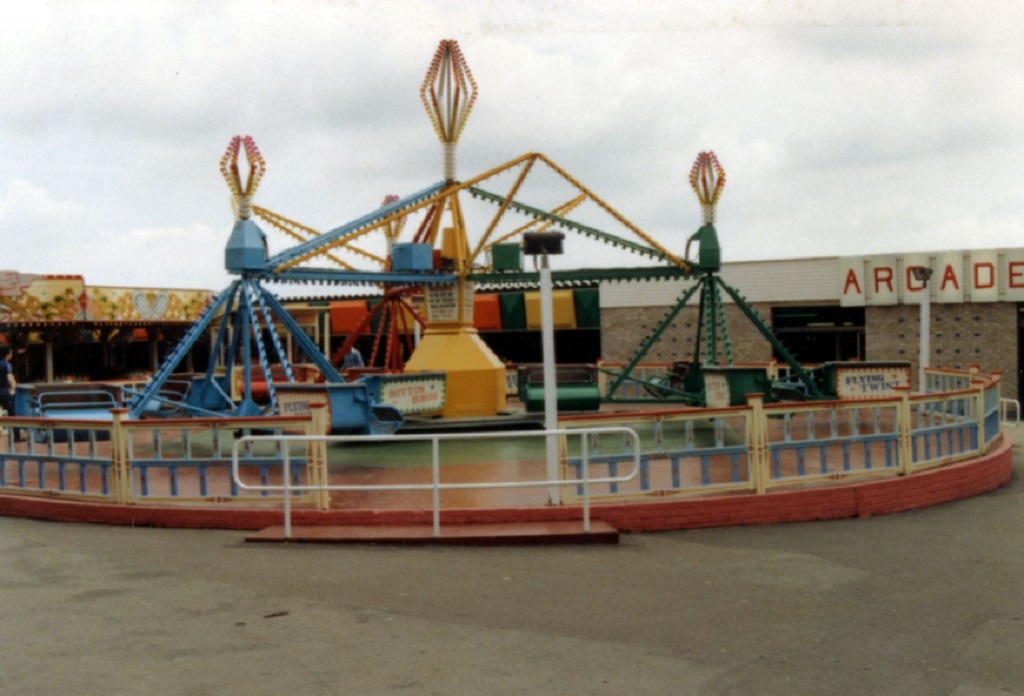
Hall built several Twists for UK showmen, including Botton Brothers, who installed their ride at Pleasure Beach in 1969. This ride, called Flying Twist, was a typical grasscutter model, featuring twelve cars in three groups of four. A concrete base featuring decorative brickwork and perimeter fencing was constructed for the ride to sit on. The ride proved extremely popular and operated successfully at Pleasure Beach each season until the end of 1992. This ride is now in use at Marleybrook House, which offers outdoor fairground weddings. 

Flying Twist at Pleasure Beach in 1969.
The Flying Twist ride at Pleasure Beach in 1969. A concrete base with decorative brickwork was constructed for the ride to sit on, although it is still considered a 'grasscutter' model. 
Image reproduced with permission of the University of Sheffield. 

Flying Twist ride at Pleasure Beach in 1978.
This image from 1978 shows the decorative features that had been added to the ride.
Image reproduced with permission of the University of Sheffield. 

Flying Twist at Pleasure Beach in 1982.
This image from 1982 shows a few modifications to the decorative lights. The ride enclosure still features the original fencing and is open, although additional fencing had been added opposite the entrances. 
Image reproduced with permission of the University of Sheffield. 
 

Flying Twist ride enclosed by higher fenching.
Whilst the ride remains essentially the same, the original perimeter fencing has been replaced by tall metal fence panels featuring the letters BA (Botton's Amusements), as more onerous safety standards dictated. 
Image reproduced with permission of the University of Sheffield.

It is testament to the original design concept that the basic design and ride experience has changed little over the years. Bennett produced Twist rides throughout the 1960s which featured a wooden platform and improvements in design aesthetics. This design was developed throughout the 1970s, culminating in production of the Sizzler in 1982. This ride features modern hydraulic drive, thicker arms, a bright colour theme with lights and a backflash, and formed the basis of most modern Twist rides. Following release of the Twister film in 1996, many rides were decorated in twister themes. 

Twister arrived at Pleasure Beach during the 1999 season. It was built by Sonacase, which at the time was run by British showman Monty Hammond. This ride is based on the Twister film, and the backflash artwork depicts the stars of the film, played by Helen Hunt and Bill Paxton, among suitably chaotic scenes inspired by the film. It is a trailer-mounted ride with slightly inclined platform featuring the classic layout of three arms supporting four cars. The ride has a capacity of 36, although it has operated at only 24 (two persons per car) since 2006. The ride is hydraulically driven, and the operator has full control over the speed and duration of the ride.

The ride was initially installed south of the Scenic Railway. It was subsequently moved to the centre of the park, although it was moved  south of the Scenic Railway again to allow installation of the Family Star ride in 2013. It remains a popular ride with visitors to Pleasure Beach. 

Twister ride at Pleasure Beach in 2011.
Twister at Pleasure Beach in 2011. 

View of the ride from the control box. The lever near centre is used to control the speed and duration of the ride. The control panel on the right includes the 'on', 'emergency stop', ‘lapbar lock' and light switches among others.